
Egg Size Guide: Compare Chicken, Duck, Quail & Specialty Eggs
Egg Size Comparison
Eggs can range from smaller than a grape to larger than a baseball. The lineup below shows
typical egg sizes to scale, arranged from smallest to largest. Use the table for
typical weight ranges and packaging fit guidance.

| Typical weight (each) | Packaging note | Source | |
|---|---|---|---|
| Button quail | ~3–5 g | Requires very small cells; not interchangeable with standard quail packaging. | |
| Quail (standard) | ~9–13 g | Fits standard quail cells (commonly 12-egg and 18-egg quail cartons). | Quail Tails |
| Jumbo quail | ~16–17 g | May be tight in smaller quail cells; look for “jumbo quail” fit if available. | Quail Tails |
| Bantam chicken | ~28–34 g | Often loose in standard chicken cells; better in smaller-cell cartons where available. | BackYard Chickens |
| Chicken (Large reference) | ~57 g (avg) | Most standard cartons fit Medium–Extra Large similarly; width is the best predictor of fit. | AMS (USDA) |
| Duck | ~70–90 g | Often wider and/or longer than chicken; choose deeper/wider cells to reduce cracking. | Heritage Farm |
| Turkey | ~65–115 g (often ~85 g) | Overlaps with large duck; use width to decide between “duck/turkey” style packaging. | The Spruce Eats |
| Goose | ~143–185 g (often ~150 g) | Usually requires specialty packaging or individual protection; standard cartons rarely fit well. | PMC |
Note: Sizes shown represent typical averages. Natural variation occurs between breeds, flocks, and seasons.
For packaging fit, egg width is usually more important than length.
Chicken Egg Size Classes (USDA Weight Standards)
Chicken egg “sizes” in the U.S. are standardized by minimum net weight per dozen.
These categories help explain why some chicken eggs overlap with smaller duck eggs.
| USDA size | Min. weight per dozen | Approx. weight per egg |
|---|---|---|
| Peewee | 15 oz / 425 g | ~35 g |
| Small | 18 oz / 510 g | ~43 g |
| Medium | 21 oz / 595 g | ~50 g |
| Large | 24 oz / 680 g | ~57 g |
| Extra Large | 27 oz / 765 g | ~64 g |
| Jumbo | 30 oz / 850 g | ~71 g |
Most cartons that fit Large chicken eggs also fit Medium–Extra Large.
Jumbo eggs may be too wide for some standard cells—use width to confirm.
What Size Egg Do I Have?
Not sure what type of egg you’re holding? Use the calculator below to estimate which egg category your egg most closely matches.
How It Works
- Measure the egg length (tip to tip).This is the longest measurement from one end of the egg to the other.
- Measure the egg width (widest point).This is the diameter across the fattest part of the egg.
- Enter both measurements using inches or millimeters.
The calculator compares your measurements against typical egg size ranges and returns the closest matching egg category.
You do not need perfect measurements. Egg size categories are ranges, not exact values.
How to measure an egg?
Visual Guide: Where to Measure
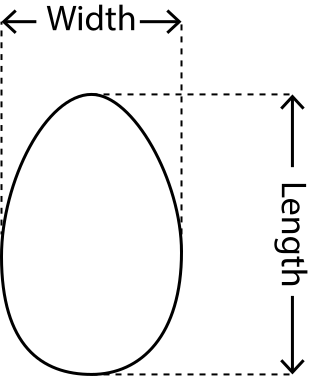
Length: Measure from the narrow end to the wide end along the longest axis.
Width: Rotate the egg and measure across the widest part.
Measuring Methods

Using Digital Calipers (Most Accurate)
- Place the egg gently between the caliper jaws.
- Measure length from tip to tip.
- Rotate the egg 90° and measure width at the widest point.
note: Use light pressure—calipers should touch the shell without squeezing.
Using a Ruler (Accurate Enough)
- Place the egg on a flat surface next to a ruler.
- Estimate length end-to-end.
- Turn the egg sideways and estimate width across the widest point.
A ruler measurement within a few millimeters is usually sufficient for categorizing egg type.
Important Notes (So Results Make Sense)
- Width predicts carton fit. If you only care about packaging, width matters more than length.
- Egg shape varies. Very round or very pointed eggs may fall near category boundaries.
- Overlaps are normal. Some Extra-Large chicken eggs overlap with small duck eggs by size.
Example Results You Might See
- “Standard Chicken Egg (Large)”
- “Jumbo Quail Egg”
- “Overlapping Range: Extra-Large Chicken or Small Duck Egg”
When measurements fall near boundaries, results should explain the overlap rather than forcing a single classification.
If your result overlaps, choose packaging based on width first.
Egg Size Calculator
Egg Size Calculator
Common Egg Size Categories Explained
Chicken Eggs (Standard vs Bantam)
Most eggs sold in grocery stores are standard chicken eggs, but not all chickens lay the same size eggs.
- Standard chickens lay eggs commonly labeled Medium, Large, or Extra-Large
- Bantam chickens are smaller birds that lay noticeably smaller eggs
While Medium, Large, and Extra-Large chicken eggs often fit the same carton, bantam eggs typically do not fit securely in standard cartons.
Egg size differences in chickens are influenced by:
- Breed
- Hen age
- Nutrition
- Time of year
Shop cartons for: Regular Chicken or Bantam Chicken eggs
Duck Eggs
Duck eggs are generally larger than chicken eggs, though size varies significantly by duck breed.
- Some small duck eggs overlap with Extra-Large chicken eggs
- Larger duck breeds lay eggs substantially wider and heavier than chicken eggs
Duck eggs are known for larger yolks and firmer whites, making them popular for baking.
Shop cartons for: Duck eggs
Quail Eggs (Standard, Jumbo & Button)
Quail eggs come in several distinct size categories:
- Standard quail eggs (Coturnix/Japanese quail) are small and speckled
- Jumbo quail eggs come from selectively bred Coturnix quail and are noticeably larger
- Button quail eggs are much smaller and belong to a different quail species
Button quail eggs are rarely sold for food and require entirely different packaging than standard quail eggs.
Shop cartons for: Standard Quail or Jumbo Quail eggs
Specialty Eggs (Turkey, Goose, Guinea, Pheasant)
Some farms also offer specialty eggs:
- Turkey eggs are similar in size to large duck eggs but are rarely sold for eating
- Goose eggs are very large—one goose egg can equal two or three chicken eggs
- Guinea fowl eggs are smaller than chicken eggs and have very thick shells
- Pheasant eggs are comparable to bantam eggs and usually seasonal
These eggs are typically sold in limited quantities and often packaged individually or in specialty cartons.
Disclaimer: This information is provided for educational purposes only and is not legal advice. Regulations change and may vary by production size and sales method. Always verify requirements with your state’s official agriculture department before selling eggs. We are not a regulatory agency and do not certify compliance.